MLM Compensation Plans: 8 Types Compared, with Examples
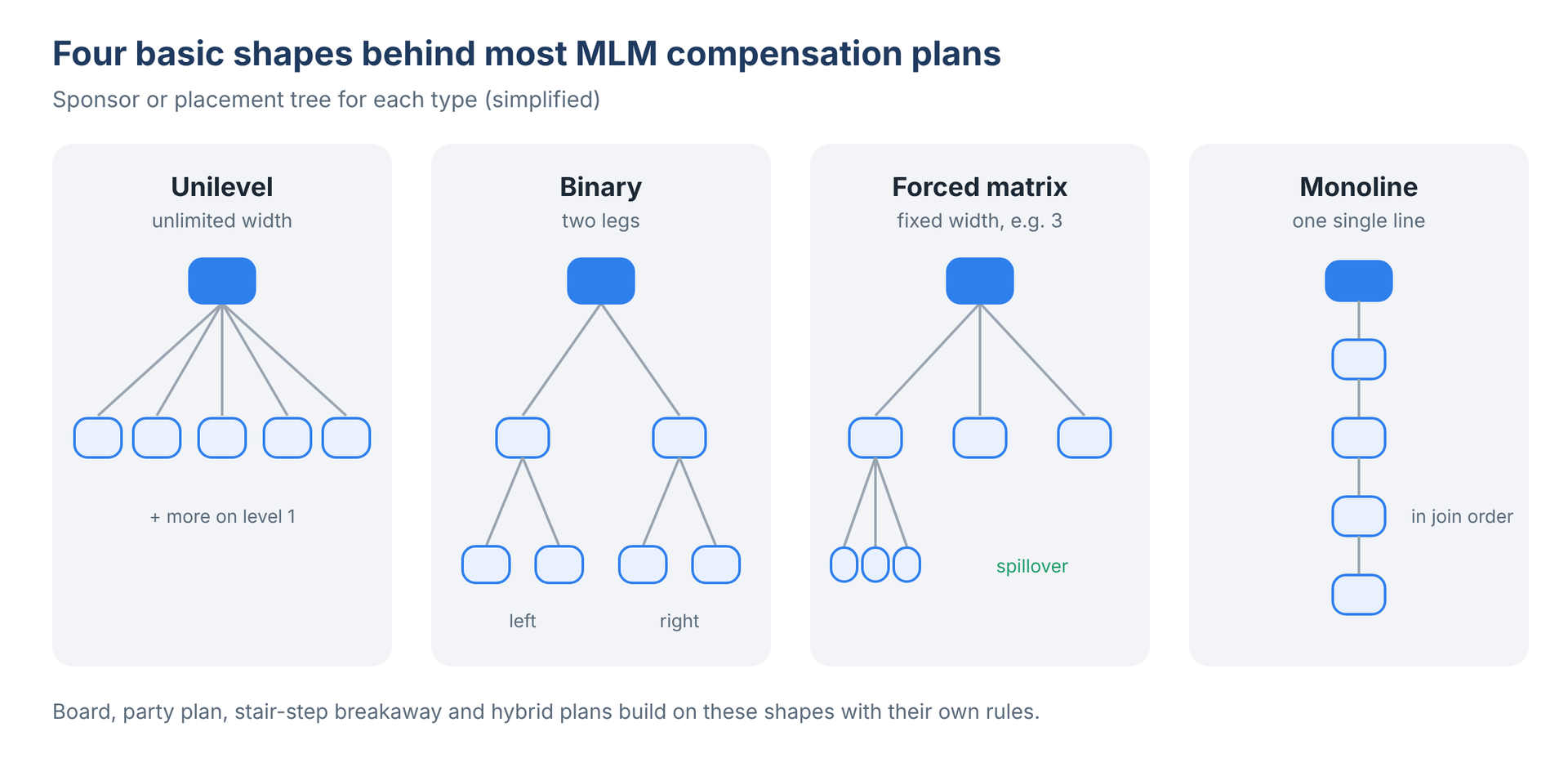
An MLM compensation plan is the set of rules a direct selling company uses to pay its distributors: how the network is structured, which sales count, who qualifies, and how commissions and bonuses are calculated. The most common types are unilevel, binary, forced matrix, board, stair-step breakaway, monoline, party plan and hybrid plans.
This guide compares all eight in one table, explains what each one rewards, and lists what to check before you choose a plan or the software that will run it.
Key takeaways
- Every plan combines a structure (the shape of the tree) with pay rules (volume, qualification, ranks and bonuses).
- The structure decides where people sit; the pay rules decide who earns what.
- Choose a plan from your sales model: retail, subscription, party or team building.
- Model the total payout before launch, and make sure pay is tied to real customer sales.
What an MLM compensation plan includes
- Structure: the shape of the sponsor or placement tree, for example unlimited width (unilevel) or two legs (binary).
- Volume: what counts toward pay, usually personal volume (PV) and group or commissionable volume measured in points.
- Qualification: conditions a distributor must meet to be paid, such as minimum personal volume or active status.
- Ranks: titles reached by meeting volume and team targets; ranks often unlock deeper levels or higher rates.
- Bonuses: the individual payouts, such as retail profit, fast start, level commission, team commission and matching bonus.
- Periods and limits: weekly or monthly calculation periods, caps, carryover and how returns are handled after a period closes.
MLM compensation plan types compared
| Plan | Structure | How distributors earn | Often used for | Watch out for |
|---|---|---|---|---|
| Unilevel | Unlimited first level | % of volume on each payable level | Retail and subscription products | Inactive accounts blocking depth; needs compression |
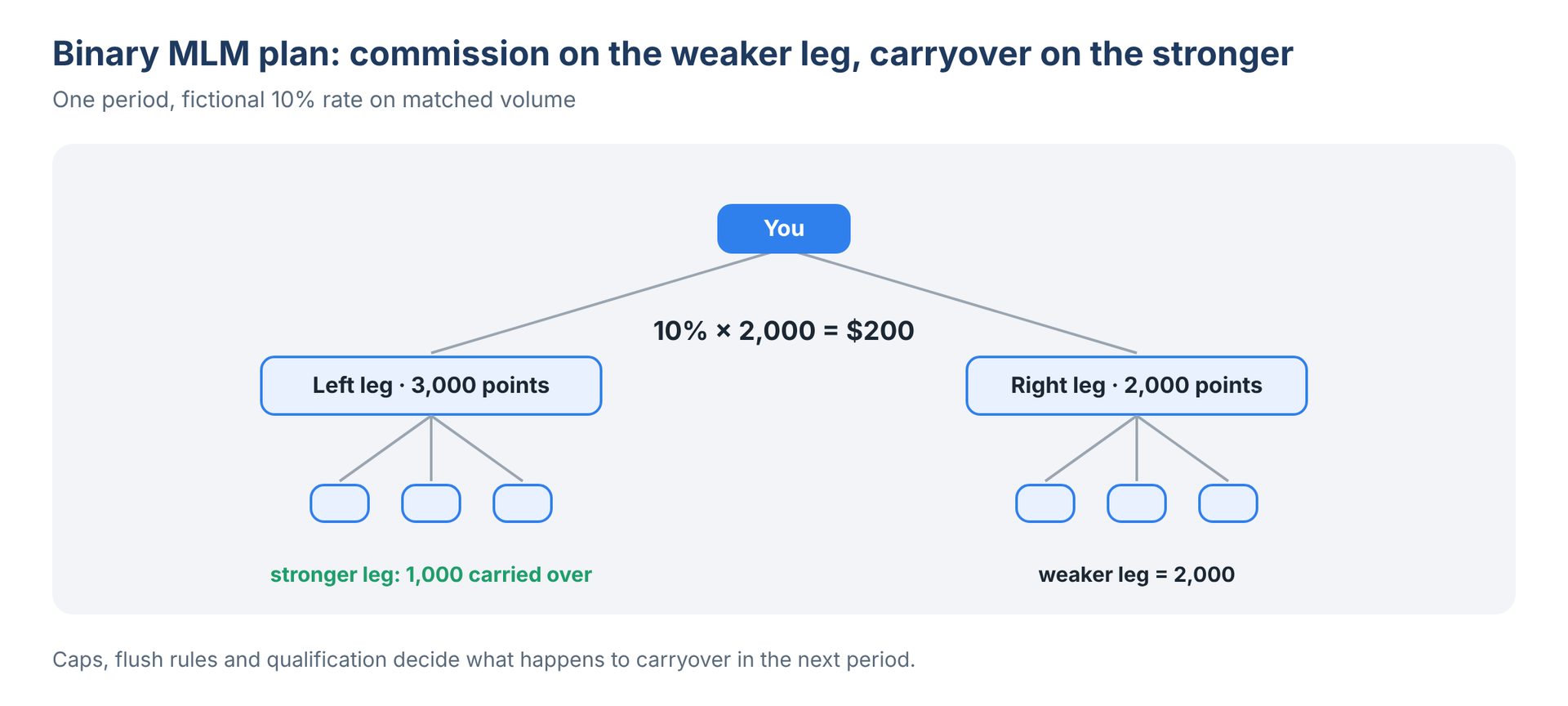
| Binary | Two legs per position | % of the weaker leg's volume | Fast team building | Carryover, caps, unbalanced legs |
| Forced matrix | Fixed width and depth, e.g. 3×7 | % of volume per level inside the matrix | Simple, capped plans | Income from spillover rather than effort |
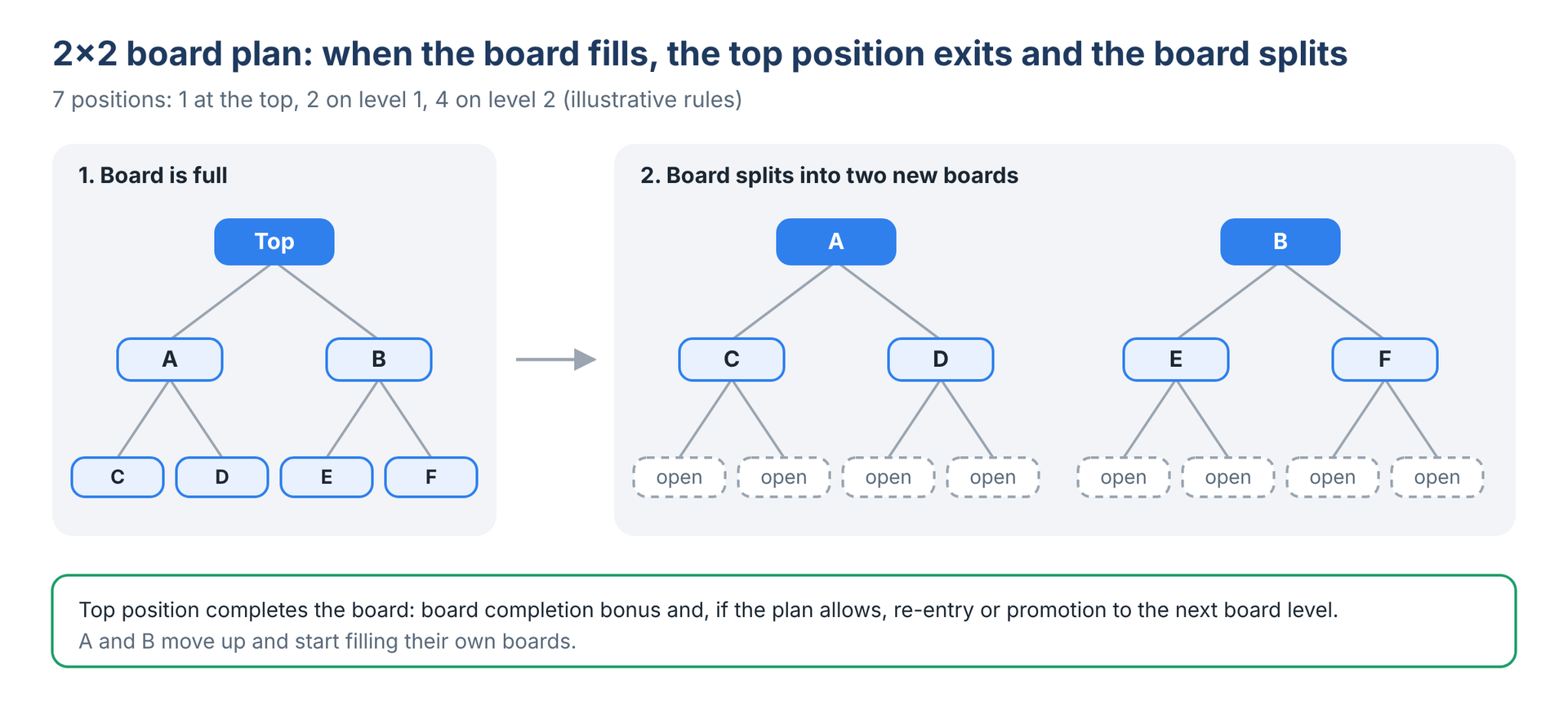
| Board | Small boards that split when full | Completion bonus when a board fills | Cycle-based programs | Dependence on new entries |
| Revolving matrix(board variant) | Matrix that cycles into a new position | Cycle bonus and re-entry | Cycle-based programs | Re-entry rules and balance treatment |
| Stair-step breakaway | Unilevel tree with breakaway legs | Differential % by rank, overrides on breakaway leaders | Long-term leadership | Complex rules; hard to explain |
| Monoline | One single line in join order | Earnings from positions added below you | Very simple programs | High regulatory risk if pay is not tied to sales |
| Party plan | Consultants, hosts and guests | Commission on party sales, host rewards, team overrides | Home and online parties | Party, guest and host data in one system |
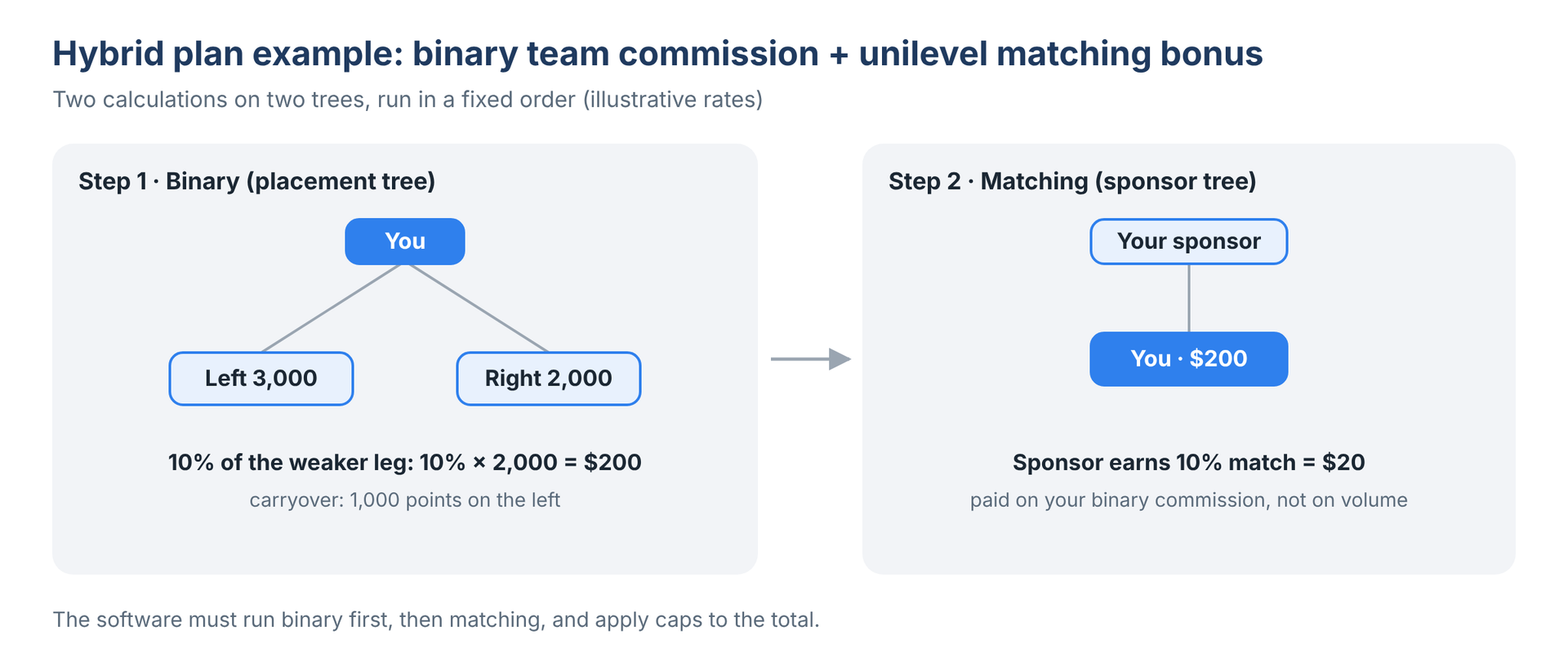
| Hybrid | Two or more structures combined | E.g. binary commission + unilevel matching | Companies needing several incentives | Total payout across components |
The eight plan types in brief
Unilevel
Everyone a distributor enrolls sits on their first level, with no width limit. Commissions are paid as a percentage of volume on a set number of levels. Read the unilevel guide.
Binary
Each position has a left and a right leg. Distributors are usually paid a percentage of the volume in their weaker leg, with the stronger leg's excess carried over. A binary guide is coming soon.
Forced matrix
Width and depth are fixed, for example 3×3. When a first level is full, new members spill over to lower positions. Read the forced matrix guide.
Board and revolving matrix
Small boards or matrices fill, pay a completion or cycle bonus, and then split or cycle into new positions. Read about board plans and revolving matrix plans.
Stair-step breakaway
Distributors move up a ladder of ranks with rising rates. When a leader reaches a set rank, their group "breaks away" and the upline earns an override instead. Read the breakaway guide.
Monoline
All members join one line in the order they sign up and earn on positions added below them. It is simple but carries a high compliance risk. Read the monoline guide .
Party plan
Consultants sell at parties that a host organizes for their friends, in person or online. Hosts earn product rewards; consultants earn commission on party sales and overrides on their team. Read the party plan guide .
Hybrid
A hybrid plan combines structures, most often a binary team commission with a unilevel matching bonus. Read the hybrid plan guide.
How to choose an MLM compensation plan
- Start from how you sell: one-off retail, subscriptions and autoship, parties, or team-based recruiting.
- Decide what behaviour you want to reward first: customer sales, personal enrollment, team building or leadership.
- Keep it explainable. If a new distributor cannot understand how they earn in five minutes, simplify.
- Model the total payout as a share of sales for realistic growth scenarios, including caps and carryover.
- Make sure pay depends on real sales to customers, not on recruitment alone, and get a legal review.
- Write the rules as test cases with expected results before you talk to software vendors.
Which plan fits which business model
| Business model | Plans that usually fit | Why |
|---|---|---|
| Retail products, one-off orders | Unilevel, stair-step breakaway | Pay follows customer sales and personal enrollment; easy to explain. |
| Subscriptions and autoship | Unilevel, binary | Recurring volume each period keeps legs and levels qualified. |
| Home and online parties | Party plan with unilevel overrides | The party is the sales unit; hosts and consultants are rewarded separately. |
| Fast team building | Binary, hybrid (binary + matching) | Two legs and matching bonuses reward building and supporting a team. |
| Small closed programs | Forced matrix, board / revolving matrix | Fixed width and cycles keep the structure small and predictable. |
Most mature companies end up with a hybrid: one main structure for team commissions plus a few bonuses, such as fast start, matching or rank advancement, that fix its weak spots.
Key terms used in compensation plans
- Personal volume (PV): the volume of a distributor's own purchases and customer sales, usually in points rather than currency.
- Group or commissionable volume (GV, CV): the volume of a team or leg that commissions are calculated on.
- Qualification: conditions a distributor must meet in a period to be paid, such as a minimum PV or an active subscription.
- Compression: skipping inactive or unqualified accounts so volume from deeper levels is paid to qualified uplines.
- Spillover: placing a new member under someone lower in the tree when the sponsor's positions are full.
- Carryover: volume on the stronger binary leg kept for the next period.
- Cap: the maximum a distributor can earn from a bonus or in total per period.
- Breakage: commission not paid out because nobody qualified for it.
Common mistakes when designing a plan
- Paying on recruitment rather than sales. Bonuses for sign-ups or entry fees create legal risk and attract the wrong people.
- Copying a competitor's plan. A plan built for another product, price point or market rarely fits yours.
- Too many bonuses. Every extra bonus makes the plan harder to explain and the total payout harder to predict.
- No payout model. Without modelling slow, expected and fast growth, the plan can pay out more than the margin allows.
- Rules that exist only in a slide deck. Unwritten edge cases, such as returns, rank drops and inactive accounts, become disputes later.
- Choosing software before the rules are final. Write the rules and test cases first, then check how each vendor runs them.
How MLM software runs a compensation plan
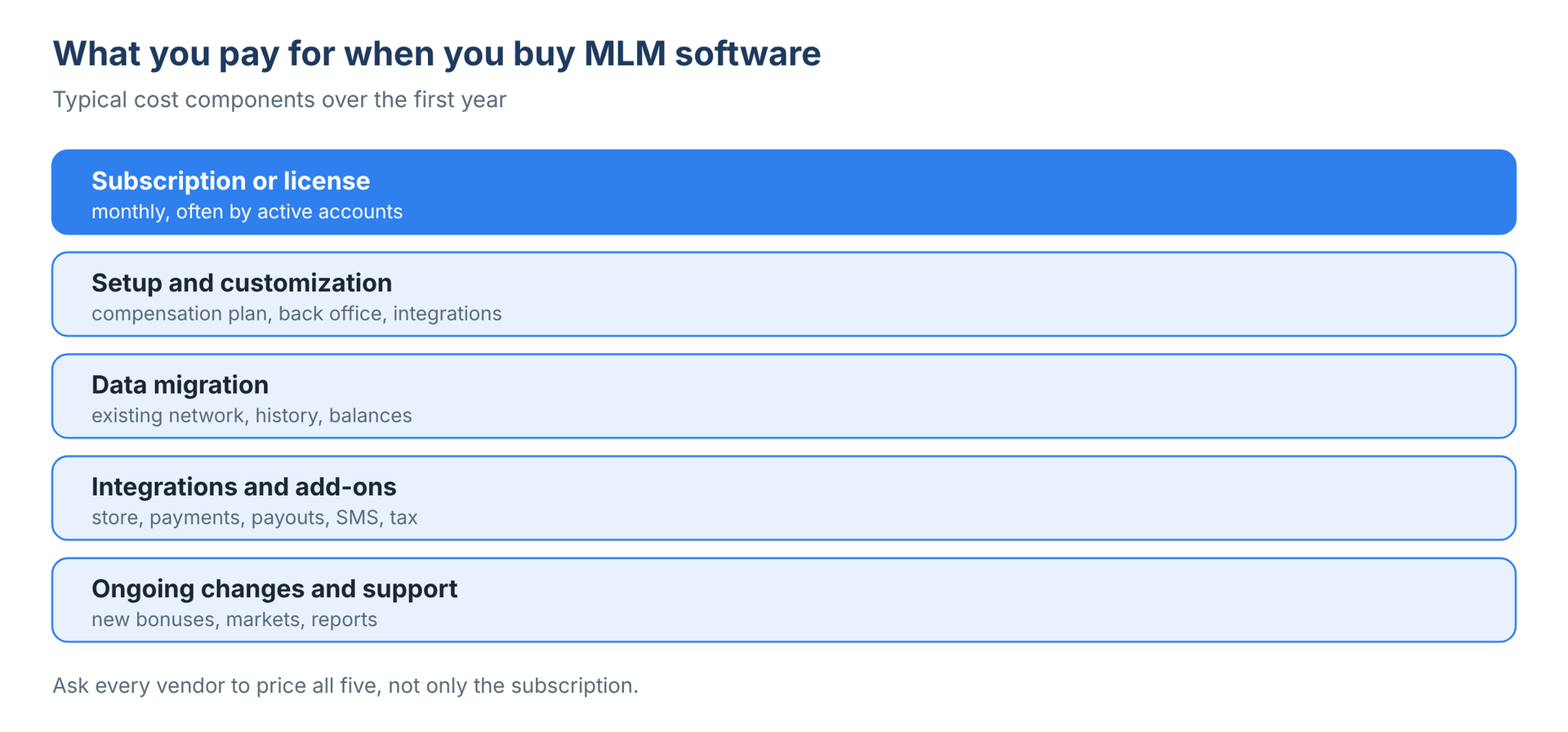
Whatever plan you choose, the software has to store the tree, collect volume from orders, check qualification and ranks, calculate each bonus in the right order, and show distributors how their pay was calculated. The MLM Soft compensation engine is configured around a company's written plan rules; administrators work in the NRM application and distributors see their results in the Online Office.
To compare vendors, use our MLM software features checklist and guide to choosing MLM software, or book a demo and bring your plan document.
MLM compensation plans: frequently asked questions
What is an MLM compensation plan?
It is the set of rules that defines how a direct selling company pays its distributors: the network structure, which volume counts, qualification, ranks and bonuses.
What are the main types of MLM compensation plans?
Unilevel, binary, forced matrix, board, stair-step breakaway, monoline, party plan and hybrid plans. Most real plans add several bonuses to one of these structures.
Which MLM compensation plan is best?
There is no single best plan. Unilevel suits retail and subscription businesses, party plans suit group selling, and binary or hybrid plans suit team building. Choose from your sales model and model the cost.
What is the difference between unilevel and binary?
A unilevel plan allows unlimited people on the first level and pays by level. A binary plan limits each position to two legs and usually pays on the weaker leg's volume.
How much of revenue do MLM plans pay out?
It varies by company and plan design. Model the total payout for your own pricing and growth scenarios, including every bonus, cap and carryover rule, before launch.
Are MLM compensation plans legal?
The plan type alone does not make a business legal or illegal. Regulators such as the US Federal Trade Commission look at whether pay is based on real sales to customers rather than recruitment. Have a qualified lawyer review your plan before launch.
Interested in Professional MLM Software? Book Free Demo with an Expert!
MLM Soft Cloud Platform is a modern high-performance software to run any multi-level or referral marketing business. Our platform is used by traditional MLM companies in health&beauty segment, as well as other industries using multi-level and/or affiliate marketing to boost their sales: infobusiness, education, real-estate, consulting, crypto, trading, etc.
Discover how we can build a customized solution for your business on MLM Soft Cloud Platform during a demo-call with one of our experts.
Please review our other blog posts which you might be interested in: