Hybrid MLM Plan: How Combined Compensation Plans Work
A hybrid MLM plan combines two or more compensation structures in one plan, for example a binary team commission with a unilevel matching bonus. Each part rewards a different behaviour. Hybrid MLM software runs each calculation on the right tree, in the right order, and applies caps to the total.
Key takeaways
- The most common hybrid is a binary team commission plus a unilevel matching bonus.
- Different parts of the plan can use different trees: placement for binary, sponsor for matching.
- Calculation order matters: a matching bonus is usually paid on commissions already calculated.
- Model the total payout across all parts, not just each part on its own.
Common hybrid combinations
| Combination | What each part rewards | Typical use |
|---|---|---|
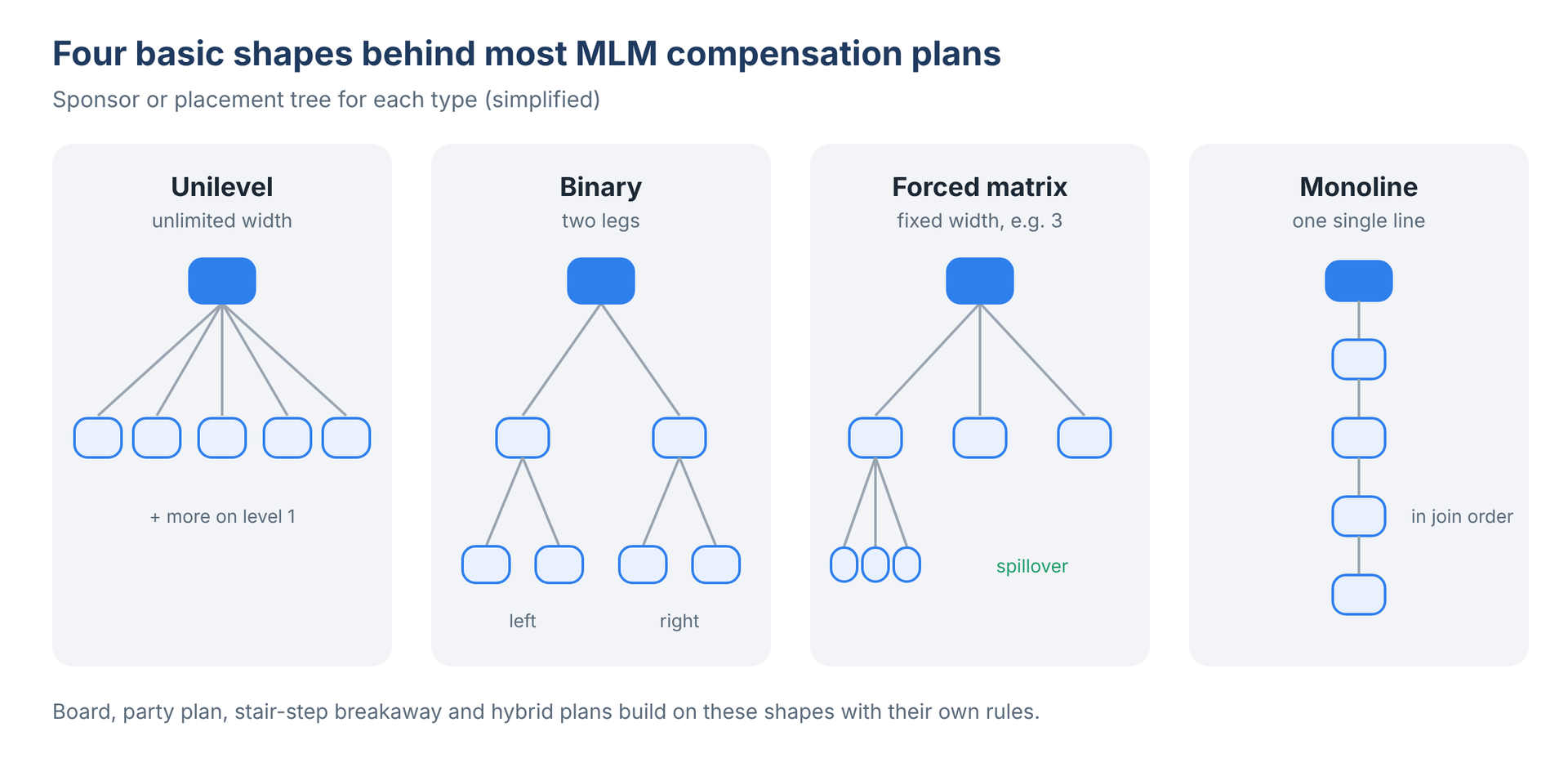
| Binary + unilevel matching | Binary pays team volume; matching pays leaders on the commissions of people they sponsored | Team building with leadership incentives |
| Unilevel + forced matrix | Unilevel pays personal enrollment; the matrix adds spillover | Simple plans with a group element |
| Stair-step breakaway + unilevel | Breakaway rewards rank; unilevel pays by level | Long-term leadership plans |
| Party plan + unilevel overrides | Party sales commission plus overrides on recruits' parties | Party plan companies |
How a binary + unilevel hybrid works, step by step
- Each distributor has a sponsor (who enrolled them) and a placement in a binary tree (left or right leg).
- Orders add volume to the legs above the buyer in the binary tree.
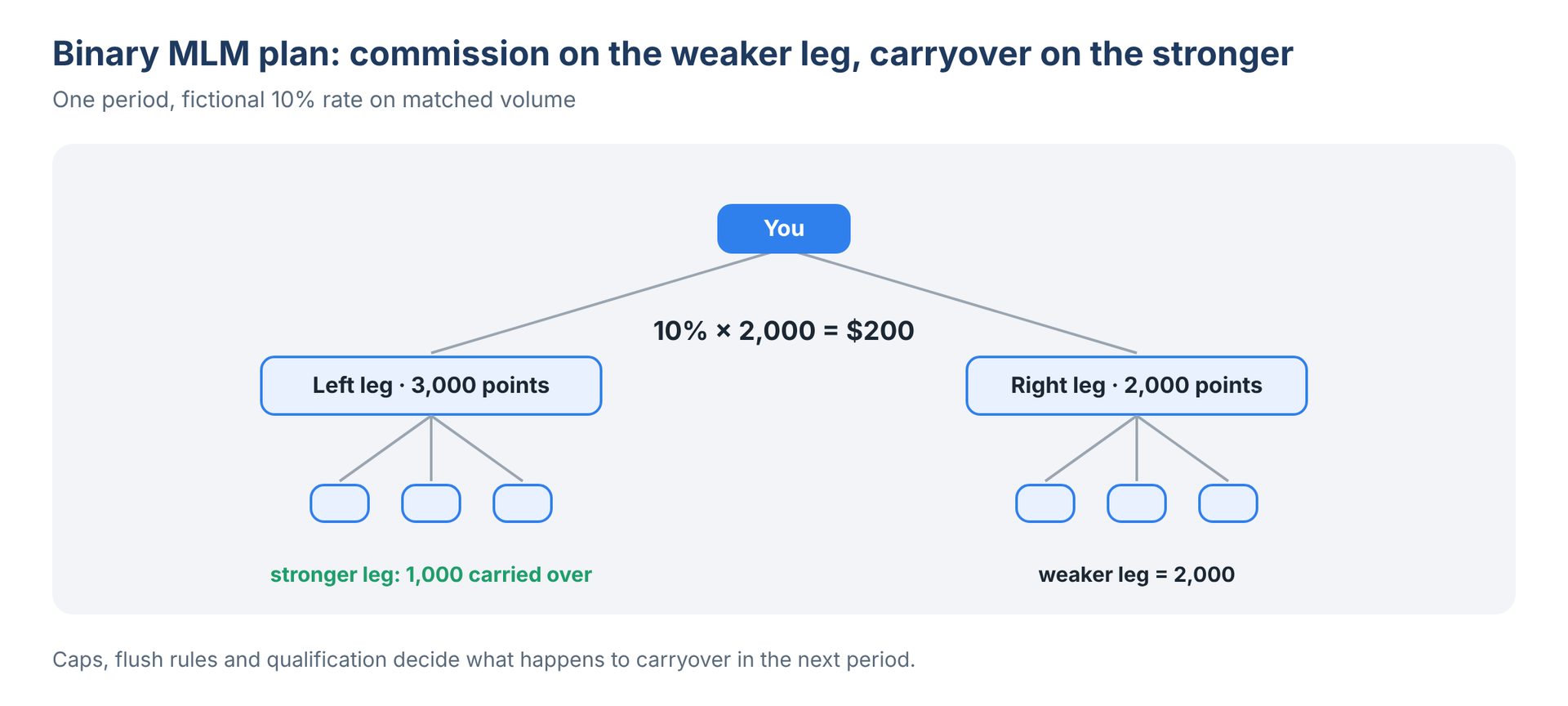
- At period end, the binary commission is calculated as a percentage of the weaker leg's volume; the excess on the stronger leg is carried over.
- The matching bonus is then calculated on those binary commissions, up the sponsor tree, for a set number of generations.
- Caps are applied to each part and to the total.
Hybrid plan example
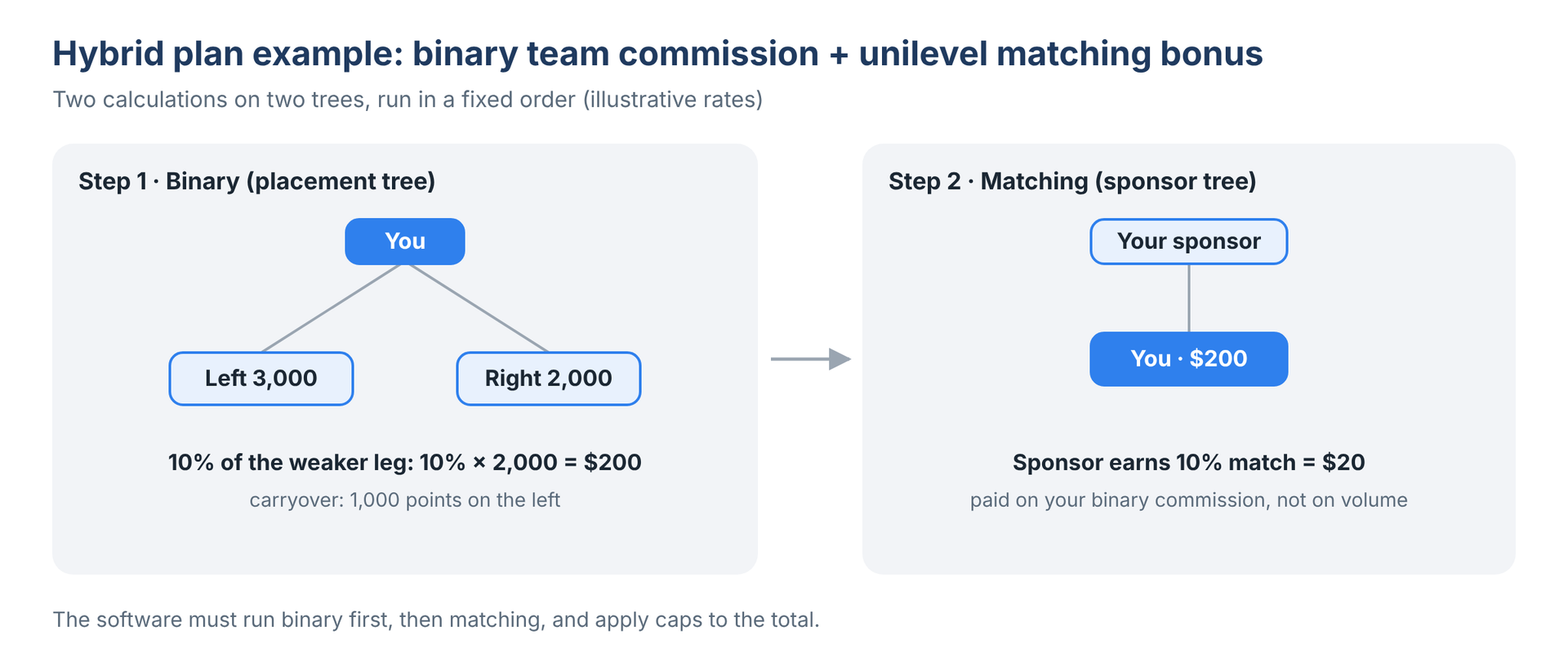
A fictional plan pays 10% of the weaker binary leg and a 10% matching bonus to the sponsor on the first generation. Rates are illustrative, not a recommended plan or an earnings forecast.
| Step | Calculation | Result |
|---|---|---|
| Binary volume | Left leg 3,000 points, right leg 2,000 points | Weaker leg: 2,000 |
| Binary commission | 10% × 2,000 | $200 |
| Carryover | 3,000 − 2,000 on the left leg | 1,000 points to next period |
| Matching bonus for the sponsor | 10% × $200 | $20 |
How to design a hybrid plan without overpaying
The risk of a hybrid plan is that each part looks affordable on its own, but together they pay more than the business can sustain. A matching bonus, for example, multiplies whatever the binary part pays. Before launch:
- Set a target for total payout as a share of commissionable sales, and check every scenario against it.
- Model at least three growth scenarios: slow, expected and fast, plus a scenario where many distributors are inactive.
- Cap each part and the total per distributor per period.
- Decide what happens to carryover volume when a distributor becomes inactive.
- Run the plan on test data in the software and compare the results with your spreadsheet model.
If a part of the plan does not change behaviour in a way you can measure, remove it. Simpler plans are easier to explain, cheaper to run and easier to defend.
Hybrid plan vs single-structure plan
| Single structure (e.g. unilevel) | Hybrid (e.g. binary + matching) | |
|---|---|---|
| Easy to explain | Yes | Harder |
| Behaviours rewarded | Mainly one | Several |
| Payout predictability | Higher | Lower without modelling |
| Software requirements | One tree, one main calculation | Two trees, ordered calculations, total caps |
Pros and cons of a hybrid plan
Pros
- Rewards several behaviours at once: sales, team building and leadership.
- Lets a company fix the weak spot of one structure with another.
- Flexible enough for companies with several product lines or markets.
Cons
- Harder to explain to new distributors.
- Total payout is harder to predict when parts interact.
- More rules to configure, test and audit.
What hybrid MLM software must handle
- Two trees for the same people: sponsor and placement.
- A fixed calculation order, for example binary before matching.
- Carryover, flush and cap rules for each part and for the total.
- Separate commission lines for each part in the distributor back office.
- Simulation of the full plan on test data before launch.
Hybrid plans on MLM Soft
The MLM Soft compensation engine is configured around your written rules for each part of the plan. Administrators check both trees and calculation history in the NRM application, and distributors see each commission line in the Online Office. Bring the rules and two or three expected calculations to a demo.
For the building blocks, see the unilevel, forced matrix and breakaway guides, or the MLM compensation plans overview.
Hybrid MLM plan: frequently asked questions
What is a hybrid MLM plan?
A compensation plan that combines two or more structures, such as a binary team commission and a unilevel matching bonus, in one plan.
What is the most common hybrid plan?
Binary plus unilevel matching: the binary part pays on team volume, and the matching part pays sponsors a share of the commissions earned by people they enrolled.
How is a matching bonus calculated?
As a percentage of the commissions earned by distributors you sponsored, for a set number of generations. In our example, 10% of a $200 binary commission is $20.
Why do companies use hybrid plans?
To reward several behaviours at once and to offset the weaknesses of a single structure.
Is a hybrid MLM plan legal?
The plan type alone does not make a business legal or illegal. Regulators such as the US Federal Trade Commission look at whether pay is based on real sales to customers rather than recruitment. Have a qualified lawyer review your plan before launch.
Interested in Professional MLM Software? Book Free Demo with an Expert!
MLM Soft Cloud Platform is a modern high-performance software to run any multi-level or referral marketing business. Our platform is used by traditional MLM companies in health&beauty segment, as well as other industries using multi-level and/or affiliate marketing to boost their sales: infobusiness, education, real-estate, consulting, crypto, trading, etc.
Discover how we can build a customized solution for your business on MLM Soft Cloud Platform during a demo-call with one of our experts.
Please review our other blog posts which you might be interested in: