Binary MLM Plan: How It Works, Commissions and Software
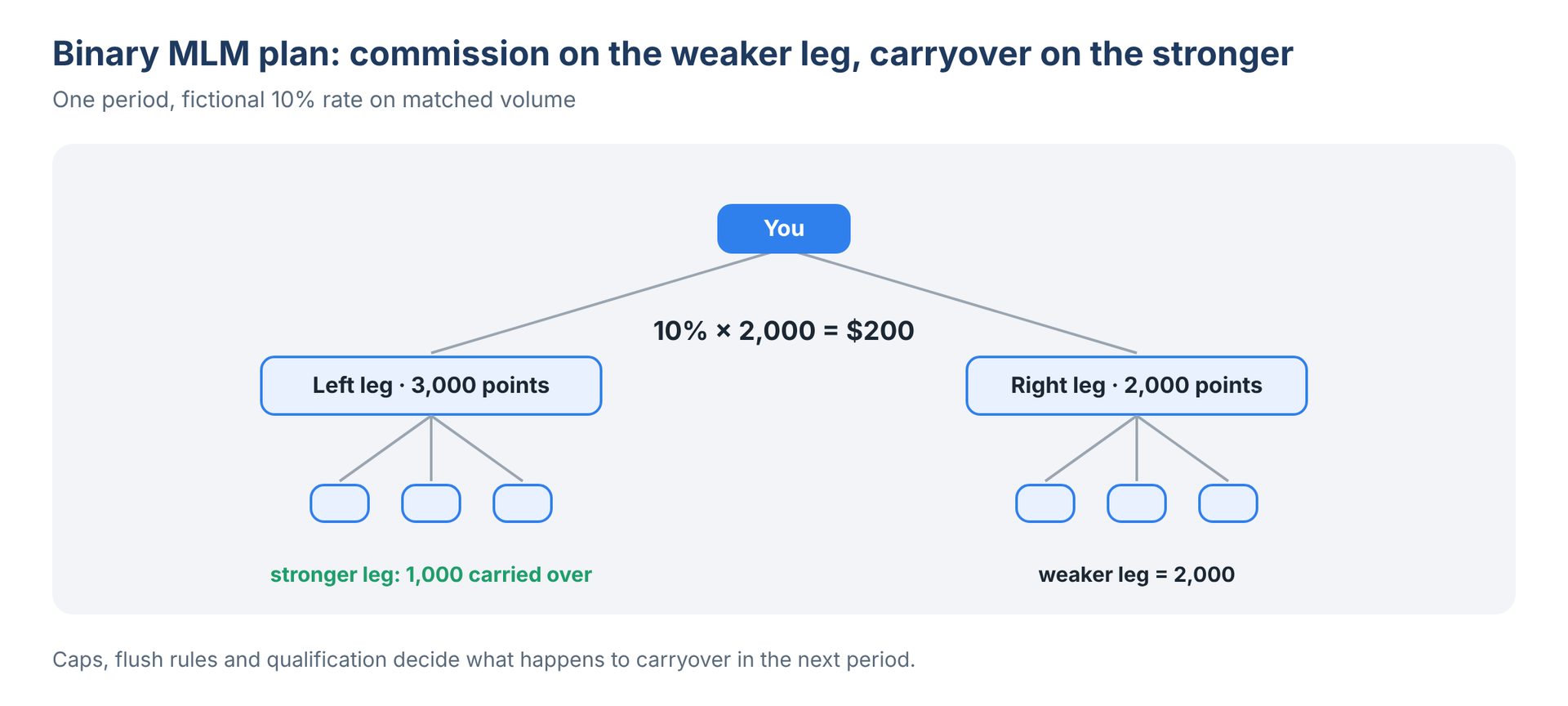
A binary MLM plan places every distributor in a tree with exactly two legs, left and right. Commissions are usually paid on the volume of the weaker leg, and unmatched volume on the stronger leg is carried over to the next period. Binary MLM software places new members in the right leg, tracks volume in both legs, applies caps and carryover rules, and shows each distributor how their commission was calculated.
Binary plans are popular because two legs are easy to explain and spillover from the upline can help new members. The rules around matching, carryover and caps are where most of the cost and most of the disputes come from.
Key takeaways
- Each position has two legs; new members go left or right by sponsor choice or an automatic rule.
- The core payout is a percentage of the weaker leg's volume for the period.
- Carryover, flush rules and caps decide how much the plan really pays.
- Sponsor and placement are separate records; matching bonuses usually follow the sponsor tree.
How a binary plan works, step by step
- A distributor enrolls a new member and places them in the left or right leg, or the system places them by rule.
- If the first position in that leg is taken, the new member goes deeper in the same leg (spillover).
- Orders from everyone in a leg add volume to that leg, usually in points.
- At the end of the period, the system compares the two legs and pays a percentage of the weaker leg.
- Unused volume on the stronger leg is carried over, subject to the plan's cap and flush rules.
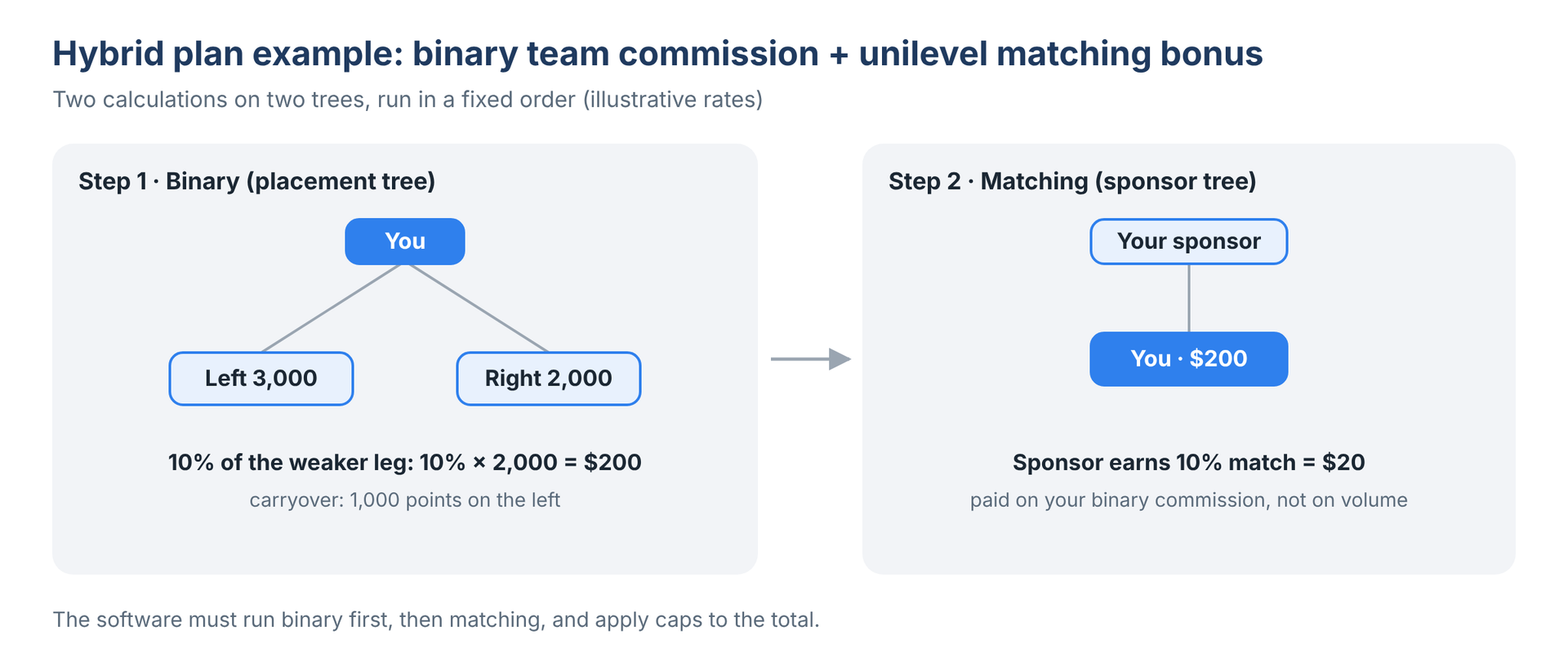
- Other bonuses, such as a matching bonus on the commissions of personally sponsored people, are calculated after the binary commission.
Binary commission example
The example uses a fictional plan that pays 10% of the weaker leg's volume, where one point equals $1. Numbers are illustrative, not a recommended plan or an earnings forecast.
| Item | Left leg | Right leg | Result |
|---|---|---|---|
| Volume this period | 3,000 | 2,000 | Weaker leg: right, 2,000 |
| Binary commission | — | — | 10% × 2,000 = $200 |
| Carryover | 1,000 | 0 | 1,000 points start the next period on the left |
| Weekly cap $150 (if the plan has one) | — | — | Paid $150; the rule must say what happens to the rest |
Binary plan terms you need to define
- Pairing or matching ratio: 1:1 matches equal volume; some plans use 1:2 or 2:1, which changes how fast legs pay.
- Carryover: unmatched volume kept for the next period, often with a limit or an expiry date.
- Flush: carryover that is deleted, for example when a distributor is inactive or the cap is reached.
- Cap: the maximum binary commission per period, per position or per rank.
- Qualification: conditions to earn, such as one active personally sponsored member in each leg and a minimum personal volume.
- Placement rule: sponsor's choice, always to the weaker leg, outside edge, or a holding tank with a time limit.
Bonuses often added to a binary plan
- Matching bonus: a percentage of the binary commissions earned by people you personally sponsored, often on several generations. See our hybrid MLM plan guide for a worked example.
- Fast-start or referral bonus: a one-time payment on a new member's first order.
- Rank advancement bonus: paid when a distributor reaches a new rank based on leg volume.
- Retail profit or customer bonus: rewards sales to customers who are not distributors.
Pros and cons of a binary plan for the company
Pros
- Easy to explain: two legs, pay on the weaker one.
- Spillover from the upline motivates new members.
- Rewards building a balanced team, not just recruiting.
Cons
- Payout can grow quickly; caps and flush rules need careful modelling.
- Distributors with one strong leg feel unpaid for their work.
- Carryover balances build up and become a liability if the rules are vague.
- Income from spillover rather than personal sales draws regulatory attention; tie qualification to real sales.
Binary vs unilevel vs forced matrix
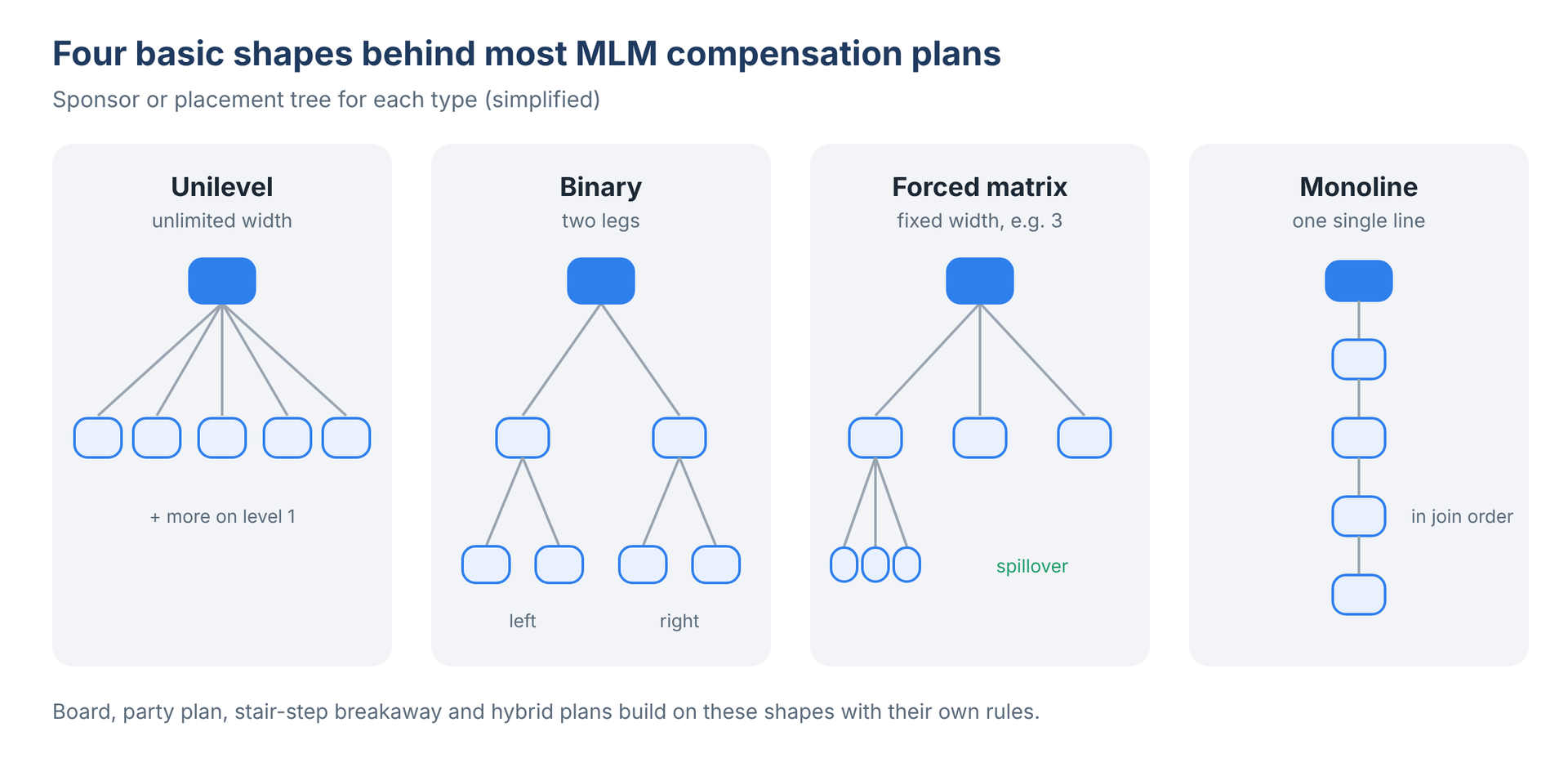
| Binary | Unilevel | Forced matrix | |
|---|---|---|---|
| First-level width | Two legs | Unlimited | Fixed, e.g. 3 |
| Main payout | % of the weaker leg | % of volume per level | % of volume per level in the matrix |
| Hard rules | Carryover, caps, flush | Compression, payable depth | Spillover order |
| Typical use | Fast team building, autoship | Retail and subscriptions | Small closed programs |
Read the unilevel guide and the forced matrix guide, or compare all types in our MLM compensation plans overview.
What binary MLM software must handle
- A placement tree with two legs, kept separate from the sponsor tree.
- Configurable placement rules, including a holding tank and locking for simultaneous sign-ups.
- Leg volume per period, with the exact moment volume is counted (order date or payment date).
- Pairing ratio, caps, carryover limits and flush rules, each configurable.
- Matching and other bonuses calculated in a fixed order after the binary commission.
- Returns after period close handled as adjustments to leg volume and carryover.
- A back office view of both legs, carryover balance and each commission line.
- Simulation on test data before launch to check total payout.
Bring these as test cases to every demo. Our MLM software features checklist lists more questions.
How MLM Soft handles binary plans
The MLM Soft compensation engine supports binary trees alongside unilevel, matrix and other structures, and is configured around your written rules for placement, carryover, caps and bonuses. Administrators review both trees and calculation history in the NRM application, and distributors see their legs and commissions in the Online Office. Book a demo and bring two or three expected calculations.
Binary MLM plan: frequently asked questions
What is a binary MLM plan?
A compensation plan in which each distributor has two legs, left and right, and is usually paid a percentage of the volume in the weaker leg each period.
How is a binary commission calculated?
Compare the volume in the two legs, take the smaller one and apply the plan's rate. In our example, 10% of a 2,000-point weaker leg is $200.
What is carryover in a binary plan?
Volume on the stronger leg that was not matched this period. It is carried to the next period, usually with limits and flush rules.
What is spillover in a binary plan?
When a position's first spot in a leg is taken, new members are placed deeper in that leg. Members below can benefit from people enrolled by their upline.
What is the difference between binary and unilevel?
Binary has two legs and pays on the weaker one; unilevel has unlimited width and pays a percentage of volume on each level.
Is a binary MLM plan legal?
The plan type alone does not make a business legal or illegal. Regulators such as the US Federal Trade Commission look at whether pay is based on real sales to customers rather than recruitment. Have a qualified lawyer review your plan before launch.
Interested in Professional MLM Software? Book Free Demo with an Expert!
MLM Soft Cloud Platform is a modern high-performance software to run any multi-level or referral marketing business. Our platform is used by traditional MLM companies in health&beauty segment, as well as other industries using multi-level and/or affiliate marketing to boost their sales: infobusiness, education, real-estate, consulting, crypto, trading, etc.
Discover how we can build a customized solution for your business on MLM Soft Cloud Platform during a demo-call with one of our experts.
Please review our other blog posts which you might be interested in: