Board MLM Plan: How Boards Fill, Split and Pay
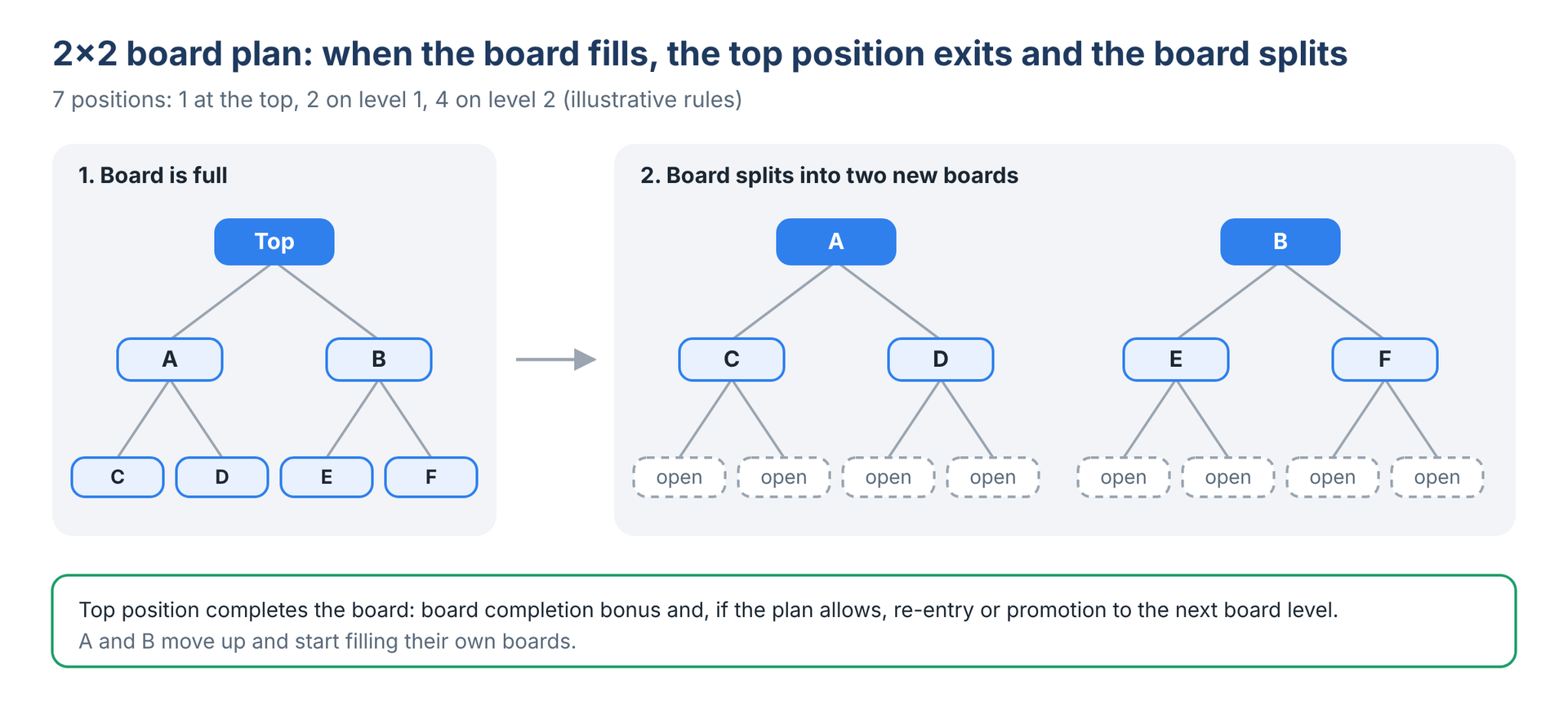
A board MLM plan places distributors on small fixed-size boards. When a board is full, the person at the top completes it, receives a completion bonus and moves on, and the board splits into two new boards led by the people below. Board MLM software keeps track of every board, places new members, detects completed boards and splits them automatically.
Board plans are also called matrix cycle plans, because each board is a small matrix that cycles. They are close relatives of the revolving matrix plan.
Key takeaways
- A common format is the 2×2 board: 1 top position, 2 on level 1 and 4 on level 2, so 7 positions in total.
- When the board fills, the top position exits with a completion bonus and the board splits in two.
- Plans often have several board levels, with a member moving up a level each time they complete a board.
- Because payouts depend on boards filling, tie qualification to product sales and get a legal review.
How a board plan works, step by step
- The company defines the board size, for example 2×2 (2 positions on level 1, 4 on level 2).
- A new member takes the next open position on a board, usually on the board of their sponsor.
- When all positions on level 2 are filled, the board is complete.
- The top position receives the board completion bonus and exits; depending on the plan, they re-enter or move to a board on the next level.
- The board splits: each level-1 member becomes the top of a new board, and the level-2 members move up to level 1 of those boards.
- The new boards start filling with new members, and the cycle repeats.
Board size: how many positions each board has
| Board | Positions per level (top, level 1, level 2 …) | Total positions | New members needed to complete |
|---|---|---|---|
| 2×2 | 1, 2, 4 | 7 | 4 on the bottom level |
| 2×3 | 1, 2, 4, 8 | 15 | 8 on the bottom level |
| 3×2 | 1, 3, 9 | 13 | 9 on the bottom level |
Larger boards pay larger completion bonuses but take longer to fill. Companies often combine a small entry board with larger boards at higher levels.
Board plan bonuses
- Board completion bonus: paid to the top position when a board fills.
- Sponsor bonus: paid to the person who enrolled a new member.
- Re-entry: a new position for the completing member on the same or a higher board level.
- Level-up bonus: paid when a member moves to the next board level.
Each bonus needs a clear trigger and an amount, and the rules for re-entry must say whether the new position is paid for, free or funded from the completion bonus.
Feeder boards, multiple boards and re-entry
Many board plans use more than one board. New members start on a small feeder board. When they complete it, they move to a main board or the next board level, where the completion bonus is larger. Some plans let a member hold positions on several boards at once.
- Single board: one board level; completing members re-enter the same board.
- Multi-board: a sequence of boards, for example feeder, level 2 and level 3, each with its own bonus.
- Re-entry: after completing, the member receives a new position, either free, paid for, or funded from the completion bonus.
- Placement rule: new members fill boards in sign-up order or under their sponsor's board; the rule must be written down exactly.
Board plan example
A fictional plan uses a 2×2 feeder board and a 2×2 main board. Amounts are illustrative, not a recommended plan or an earnings forecast.
| Event | Rule | Result |
|---|---|---|
| Feeder board completes | 4 new positions filled on level 2 | Top member earns a $100 completion bonus |
| Re-entry | $40 of the bonus funds a new feeder position | Member keeps $60 and stays in the feeder cycle |
| Move up | Top member is placed on the main board | Next completion pays $400 |
| Split | Level-1 members each lead a new feeder board | Two new boards start filling |
Write each event as a test case like this before configuring software: who moves where, what is paid, and what happens to the re-entry position.
Board vs forced matrix vs revolving matrix
| Board plan | Forced matrix | Revolving matrix | |
|---|---|---|---|
| When full | Top exits, board splits in two | Payouts stop at the defined depth | Account cycles; a new position opens |
| Main payout | Completion bonus per board | % of volume per level | Cycle bonus |
| Placement | Next open position on the board | Spillover inside one matrix | Next open position in the cycle |
| Key rules to define | Split order, re-entry, board levels | Width, depth, spillover order | Cycle trigger, re-entry, balance |
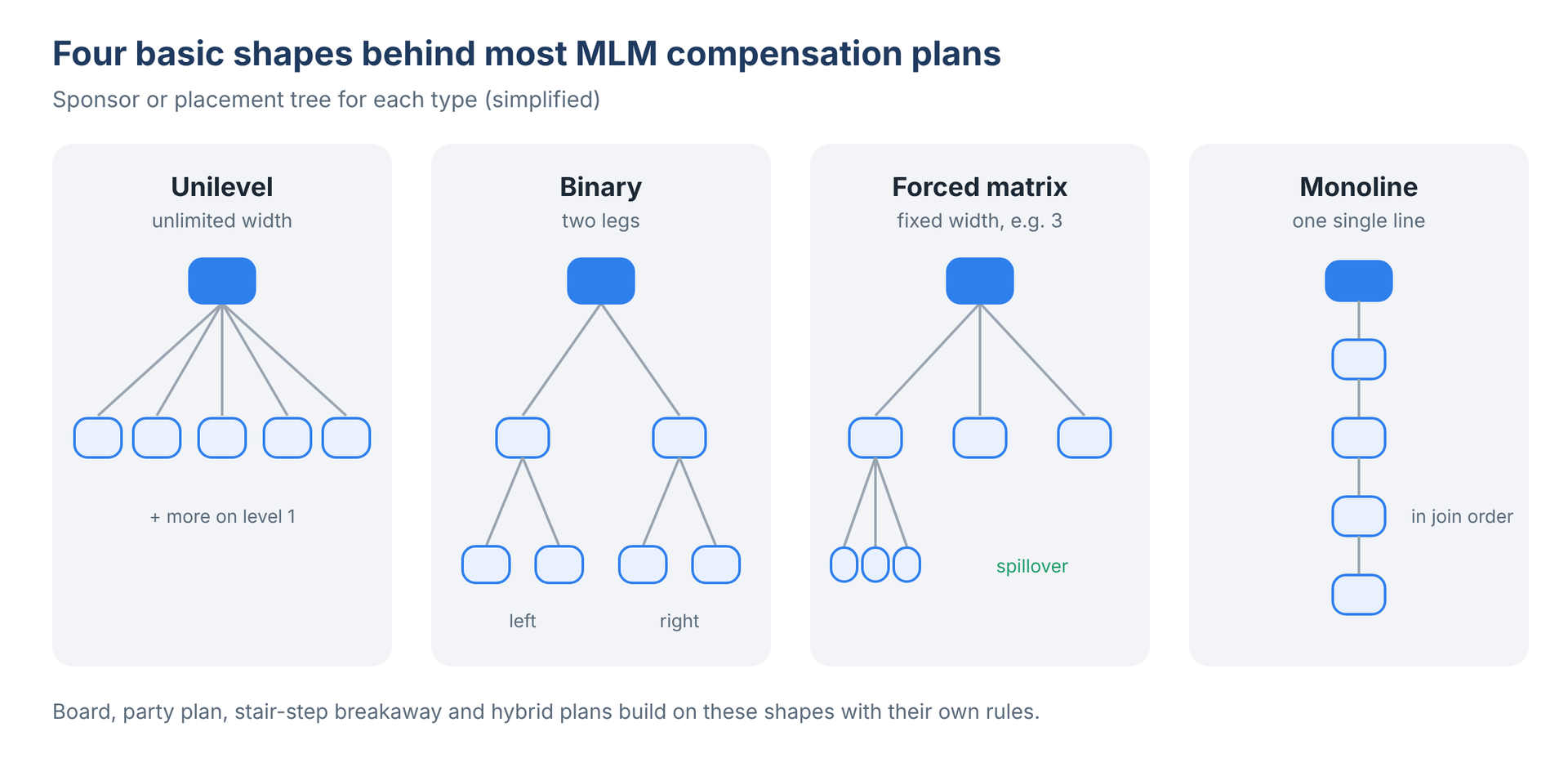
See the forced matrix guide and the revolving matrix guide for details, or compare all types in our MLM compensation plans overview.
Pros and cons of a board plan for the company
Pros
- Easy to visualize and explain.
- Clear milestones: a completed board is a visible achievement.
- Fixed bonus amounts make each board's cost predictable.
Cons
- Earnings depend on new members filling boards, which attracts regulatory scrutiny if not tied to product sales.
- Members low on a board may wait a long time when growth slows.
- Re-entry and multi-level boards make the rules harder to audit.
What board MLM software must handle
- Configurable board size and several board levels.
- Correct placement order on each board and locking so two sign-ups cannot take the same position.
- Automatic detection of a completed board and an exact, repeatable split rule.
- Completion, sponsor, re-entry and level-up bonuses with their qualification rules.
- Re-entry positions linked to the same account, with full history of every board a member sat on.
- Reports that show every board, its positions and its status for administrators and distributors.
How MLM Soft handles board and cycle plans
The MLM Soft compensation engine is configured around written plan rules, including cycle-based structures. Our RevolverMatrix client case shows how a revolving structure is displayed to distributors in the personal account, and administrators review positions and history in the NRM application. Bring your board rules to a demo to confirm which parts are configuration and which need project work.
Board MLM plan: frequently asked questions
What is a board plan in MLM?
A board plan places members on small fixed-size boards. When a board fills, the top member receives a completion bonus and exits, and the board splits into two new boards.
How many people are on a 2×2 board?
Seven positions: one at the top, two on level 1 and four on level 2. The board completes when the four bottom positions are filled.
What happens when a board splits?
The two level-1 members each become the top of a new board, and the level-2 members move up under them. The new boards then fill with new members.
What is the difference between a board plan and a revolving matrix?
Both cycle. A board plan splits the full board into two new boards, while a revolving matrix cycles the completing account into a new position, usually without splitting.
Is a board MLM plan legal?
The plan type alone does not make a business legal or illegal. Regulators such as the US Federal Trade Commission look at whether pay is based on real sales to customers rather than recruitment. Have a qualified lawyer review your plan before launch.
Interested in Professional MLM Software? Book Free Demo with an Expert!
MLM Soft Cloud Platform is a modern high-performance software to run any multi-level or referral marketing business. Our platform is used by traditional MLM companies in health&beauty segment, as well as other industries using multi-level and/or affiliate marketing to boost their sales: infobusiness, education, real-estate, consulting, crypto, trading, etc.
Discover how we can build a customized solution for your business on MLM Soft Cloud Platform during a demo-call with one of our experts.
Please review our other blog posts which you might be interested in: